| A Survey in 1986 by Mr. B Giggins, of Towcester
Cobblers Workshops at rear of 35 Newton Road, Rushden
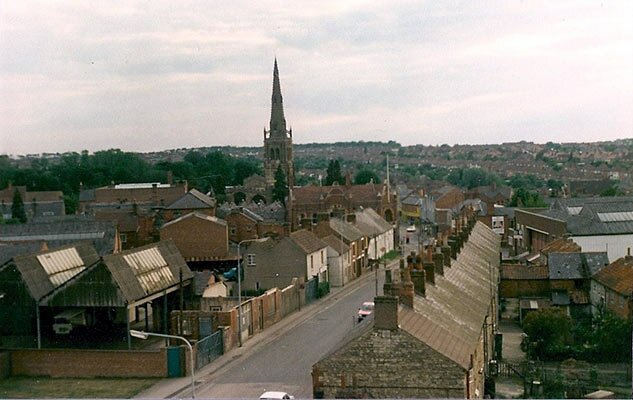
In the rear gardens of 31 - 55 Newton Road, Rushden stood a row of outbuildings comprising of w.c.'s, wash-houses and cobblers workshops. These brick buildings were of insubstantial construction, mostly single skin brickwork with pantiled or slated roofs are typical of the outbuildings of artisan dwellings constructed during the Victorian period. Of particular note, however, were two pairs of two storey semi-detached workshops which appeared to be contemporary with the construction of the terrace in 1861. Although two storey workshops are far from uncommon in Northamptonshire these were some of the last examples surviving in Rushden one of the foremost shoe producing towns in the County.
 |
|
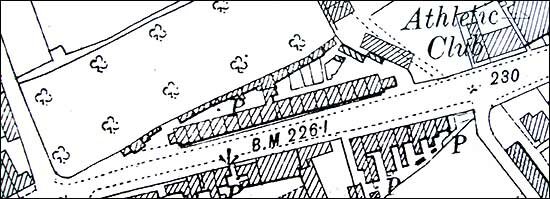
Ebenezer Terrace and Workshops (centre), Fire Station and Athletic Club (top right),
junction of Newton Road and Rectory Road (bottom left) 1911 map
|
The accommodation of the houses in the terrace comprised of two rooms and a pantry on the ground floor and two bedrooms above. For economy brick was used on the front elevation and stone on the rear and gables. Unlike the artisan dwellings constructed later in the century the houses lacked the rear extensions which contained the back kitchen/wash-house. For this reason the wash-houses were incorporated in the outbuildings at the bottom of the gardens.
An inspection of the outbuildings showed that they all varied in size and layout which suggests that they were built to the requirements of the tenants and not as part of the building scheme. In particular there were variations in the construction the workshops. Fronting Newton road at the end of the terrace next to number 55 was a low single storey building with two large windows. This was a pair of workshops which had the room with the cobbler’s bench etc. in the front and a wash-house, in the room behind. Access to the front workshop was through the wash-house. The other workshops were set against the rear boundary of the site. Five of these were two storeys in height and had the room where the cobbler worked on the first floor and a wash-house below. Despite four of these being constructed as semi-detached buildings, there were still variations as to size and the arrangement of windows. Such variations do not exist where the workshops are part of the building scheme e.g. St. Michael's Road; Northampton and Swann Terrace, East St., Long Buckby.
The workshop at the rear of 35 Newton Road was the best preserved of the two storey workshops and of standard construction. Brickwork was used for the external walls but for economy the builder constructed them of a single brick thickness i.e. four and a half inches thick. He also made use of the stone boundary wall at the rear of the plots and built the back walls off the top of this. Similarly he cut down costs of roof construction by building a tall back wall to support a monopitched roof of clay pantilesa cheap roofing material which in Northamptonshire was used mainly for outbuildings and barns. Even chimney pots were too expensive so drainage pipes were used in their place.
The accommodation that this building provided was a wash-house approximately 2.4m x 1.9m on the ground floor and a first floor workshop approximately 4.7m x 2.2m. In the wash-house were a cast-iron range with a single oven, the base of a coal fired washing copper and a sink. Bricks were used as the flooring material of this room. There was no pumped water supply available for use so soft wafer was obtained from the water butt outside.
Adjacent to the wash-house was the entrance lobby which contained the stairs to the first floor and a small cupboard for storing coal. A doorway was constructed at the base of the timber stairs to enable the first floor to be locked off. The cobblers workshop on the first floor was very basic and comprised of a bench or benches in front of two large wooden casement windows. It was heated by a small fireplace against the rear wall and in some of the other workshops gas lighting was provided.
The size of the workshop is slightly smaller than the rear addition workshops commonly found in terraced housing around the shoe factories in Northampton but larger than the 1.5m x 2.5m two storey cobblers workshops at Swann Cottages, Long Buckby. It is possible that it could have been used by up to four cobblers. Did the cobbler therefore employ labour or was it a "family" business where the children assisted? From the accommodation of the houses and the construction of the workshops it is apparent that cobblers were comparatively poor and probably outworkers for a shoe warehouse or factory.
It would be interesting to know whether the workshops were used when the washing was being done or whether this was another excuse for the cobblers not to work on Mondays.
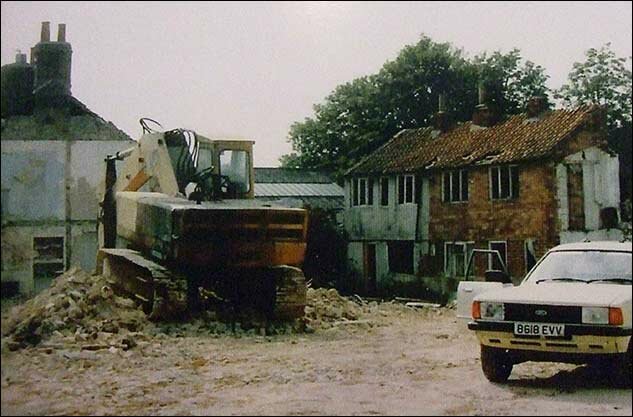
When visited in March 1986 the houses and workshops had been compulsorily purchased and due for demolition. Attempts were being made to save sufficient materials to enable one of the two storey workshops to be rebuilt in the town at a later date.
|